OnePlus 13R India Review: The Best Phone Under ₹40,000?
Is the OnePlus 13R the best value flagship killer of the year? Our in-depth review explores its Snapdragon 8 Gen 3 power, massive 6000mAh battery, new 50MP zoom camera, and reveals the compromises you need to know about before you buy. Here is the OnePlus 13R Review.

The OnePlus 13R arrives as a compelling new entry in the smartphone market, building on the successful legacy of its predecessor, the OnePlus 12R. Positioned as a more accessible variant of the flagship OnePlus 13, this device masterfully blends premium features with intelligent compromises to achieve a budget-friendly price point. Read the OnePlus 13R Review.
Continuing its tradition, OnePlus equips the 13R with last year’s top-tier processor, the formidable Snapdragon 8 Gen 3. The display remains a highlight, with the phone boasting the same impressive 6.78-inch LTPO OLED panel that fans loved. However, the 13R isn’t just a minor refresh. It introduces significant upgrades, most notably in the camera department with the addition of a versatile 50MP 2x telephoto lens and a groundbreaking 6,000 mAh silicon-carbon battery. While the OnePlus 12R set a high bar for performance and value in 2024, the OnePlus 13R, with its thoughtful enhancements, is perfectly poised to not only fill those shoes but to create a new benchmark for its category.
OnePlus 13R specs at a glance:
- Body: 161.7×75.8×8.0 mm, 206g; Glass front (Gorilla Glass 7i), aluminum frame, glass back; IP65, waterproof and dustproof.
- Display: 6.78″ LTPO4.1 AMOLED, 1B colors, 120Hz, HDR10+, Dolby Vision, 1800 nits (HBM), 4500 nits (peak), 1264×2780px resolution, 19.79:9 aspect ratio, 450ppi.
- Chipset: Qualcomm SM8650-AB Snapdragon 8 Gen 3 (4 nm): Octa-core (1×3.3 GHz Cortex-X4 & 3×3.2 GHz Cortex-A720 & 2×3.0 GHz Cortex-A720 & 2×2.3 GHz Cortex-A520); Adreno 750.
- Memory: 256GB 12GB RAM, 512GB 16GB RAM; UFS 4.0.
- OS/Software: Android 15, OxygenOS 15, up to 4 years of Android upgrades.
- Rear camera: Wide (main): 50 MP, f/1.8, 24mm, 1/1.56″, 1.0µm, multi-directional PDAF, OIS; Telephoto: 50 MP, PDAF, 2x optical zoom; Ultra wide angle: 8 MP, f/2.2, 16mm, 112˚, 1/4.0″, 1.12µm.
- Front camera: 16 MP, f/2.4, 26mm (wide), 1/3″, 1.0µm.
- Video capture: Rear camera: 4K@30/60fps, 1080p@30/60/120/240fps, gyro-EIS, OIS; Front camera: 1080p@30fps, gyro-EIS.
- Battery: 6000mAh; 80W wired charging.
- Connectivity: 5G; Wi-Fi 7; BT 5.3, aptX HD; NFC; Infrared port.
- Misc: Fingerprint reader (under display, optical); stereo speakers.
Unboxing the OnePlus 13R
The retail experience for the OnePlus 13R is notably minimalist, at least for our European unit. Inside the box, you will find the phone itself and a single USB-A to USB-C cable. Conspicuously absent are a charging adapter and a protective case, which means you’ll need to purchase them separately to take advantage of the phone’s 80W SuperVOOC fast charging. It’s important to note that packaging contents can vary by region, so we recommend confirming with your local retailer if a charger is included in your market. complete OnePlus 13R Review.
Design and ergonomics
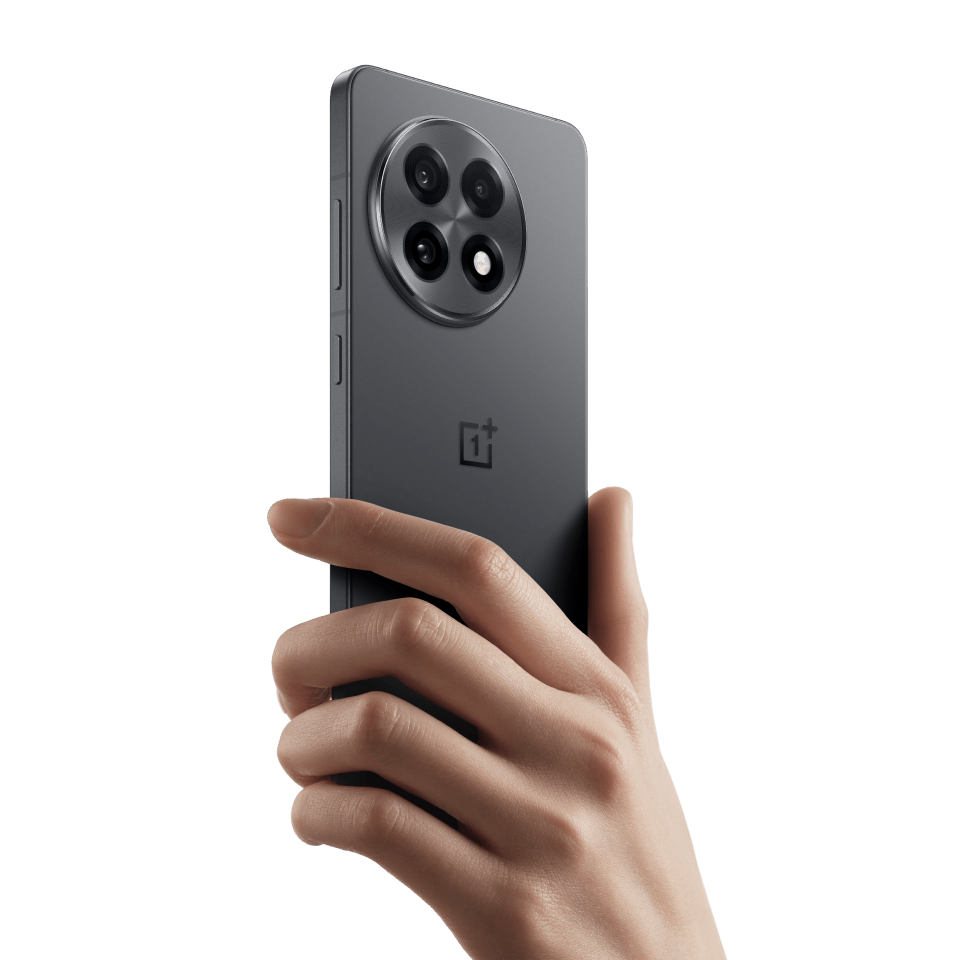
The OnePlus 13R sports a fresh design language that aligns it with the flagship OnePlus 13 and the contemporary Oppo Find X8 series. This marks a departure from the curved displays and frames of the past generation, embracing a modern aesthetic with a flat front, a flat back, and a flat-sided aluminum frame.
The build quality remains premium, with a Gorilla Glass 7i front panel and an aluminum chassis. The back panel is also glass, but features a unique concentric, slightly roughened texture that could be mistaken for metal or high-quality plastic. This new flat design fundamentally changes how the phone feels in hand. While the anodized frame and glass back are inherently slick, the sharp, flat edges provide a more defined surface to grip. However, this design can be polarizing; some users will appreciate the secure hold, while others may find the sharp chassis less comfortable during extended use.
Thankfully, practical features like the IP65 rating for dust and water resistance and the beloved Alert Slider make a welcome return. One ergonomic drawback, however, is the placement of the in-display fingerprint scanner. While the sensor itself is fast and reliable, it is positioned too close to the bottom of the screen, making it somewhat awkward to reach naturally with your thumb.
Overall, the design of the OnePlus 13R feels premium and contemporary. While the flat aesthetic and off-center camera module might not appeal to everyone, it’s a confident step in a new direction. A higher ingress protection rating would have been a welcome addition, but the overall package is impressively well-built.
120Hz LTPO OLED display
The OnePlus 13R is equipped with a stunning 6.78-inch LTPO4.1 AMOLED display, featuring a sharp 1,264×2,780px resolution. This panel supports 10-bit color depth, a fluid 120Hz refresh rate, and is certified for top-tier HDR formats like HDR10+ and Dolby Vision, ensuring a spectacular viewing experience on streaming services like Netflix and YouTube.
Based on its specifications and our test results, this appears to be the same high-quality panel used in the flagship OnePlus 13. In our brightness testing, the display reached a respectable 820 nits in manual mode. When set to auto-brightness, it peaked at 1,223 nits, which is sufficient for clear visibility on a bright, sunny day, though it does trail some of its direct competitors in outright luminosity.
Max display brightness test | White test pattern, 75% fill (nits) | Manual mode | Auto mode | | :— | :— | :— | | Motorola Edge 50 Ultra | 1473 | | | Galaxy S24 FE | 1372 | | | vivo V40 Pro | 1307 | | | Xiaomi 14T Pro | 1228 | | | OnePlus 13R | 820 | 1223 | | OnePlus 12R | | 1181 |
Refresh rate
The device offers three refresh rate settings: Standard (locked to 60Hz), High (forces 120Hz where possible), and Auto (intelligently adjusts the refresh rate). In Auto mode, apps like Chrome might run at 90Hz, but switching to High mode will push them to a buttery-smooth 120Hz. The LTPO technology works effectively, dialing down to 1Hz to save power when viewing static content. However, the system does not perfectly match the framerate for 24fps videos, instead defaulting to a higher refresh rate.
Battery life
One of the headline features of the OnePlus 13R is its new single-cell silicon-carbon battery, which boasts a massive 6,000 mAh capacity. This upgrade results in a noticeable improvement over its already long-lasting predecessor, particularly in web browsing and gaming endurance. In our comprehensive battery tests, the OnePlus 13R consistently outperformed most of its rivals, a testament to the exceptional power efficiency often seen in devices running OxygenOS and its sibling software platforms.
| Active use score | Calls | Web | Video | Gaming |
| OnePlus 13R (6000 mAh) | 15:09h | 25:00h | 14:01h | 19:37h |
| OnePlus 12R (5500 mAh) | 14:32h | 39:09h | 12:57h | 20:30h |
| vivo V40 Pro (5500 mAh) | 13:45h | 28:45h | 13:22h | 12:50h |
| Xiaomi 14T Pro (5000 mAh) | 12:32h | 24:46h | 11:53h | 13:50h |
| Motorola Edge 50 Ultra (4500 mAh) | 12:56h | 28:32h | 9:56h | 17:37h |
Export to Sheets
Charging speed
This year, the OnePlus 13R sees a slight adjustment in its charging technology, supporting 80W SuperVOOC charging, a step down from the 100W on the 12R. While still incredibly fast, it no longer leads the pack. A full charge from 0% to 100% takes a respectable 48 minutes. This slightly slower speed is likely due to the new, larger 6,000 mAh silicon-carbon battery technology, which can have different charging characteristics. Despite this, it remains significantly faster than many competitors.
Charging speed | | in 15 min | in 30 min | Time to full charge | | :— | :— | :— | :— | | OnePlus 12R (100W) | | | 26 min | | Xiaomi 14T Pro (120W) | | | 27 min | | Motorola Edge 50 Ultra (125W) | | | 31 min | | Realme GT 7 Pro (120W) | 94% | | 32 min | | OnePlus 13R (80W) | 39% | 73% | 48 min | | Galaxy S24 FE (25W) | 30% | 56% | 1h 22min |
For users concerned about long-term battery health, OnePlus includes several intelligent charging options, such as Smart rapid charging and the ability to limit the maximum charge to 80%.
Speakers
The OnePlus 13R features a standard hybrid stereo speaker configuration, with a primary downward-firing speaker and an earpiece that doubles as a second channel. As expected, the bottom speaker is more powerful than the earpiece.
In terms of volume, the speakers are exceptionally loud, earning an “Excellent” rating in our tests with a score of -23.4 LUFS. However, audio quality at maximum volume is not flawless. While tracks sound full with a decent amount of bass, the vocals and high frequencies can sound slightly distorted or “ring.” For the best listening experience, keeping the volume a couple of notches below the maximum is recommended.
OxygenOS 15 + Android 15
Running on the latest OxygenOS 15, based on Android 15, the OnePlus 13R delivers a clean, fast, and feature-rich software experience. OxygenOS shares its core DNA with Oppo’s ColorOS and Realme’s Realme UI, offering a highly polished and stable platform. OnePlus makes a strong commitment to longevity, promising an impressive 4 years of major Android updates and 6 years of security patches.
The software is packed with useful AI features. Google’s Circle to Search is integrated, and the Gemini AI assistant is available out of the box. An “AI toolbox” accessible from the Smart Sidebar offers utilities like AI Summary to condense text, AI Speak to read articles aloud, and AI Writer to help compose text. The gallery app also includes powerful editing tools like AI Eraser, AI Unblur, and AI Reflection Eraser. However, the AI Studio app for creating photorealistic avatars is not included.
Benchmark performance
True to the “R” series formula, the OnePlus 13R is powered by Qualcomm’s previous-generation flagship chipset, the Snapdragon 8 Gen 3. This is the same powerful SoC found in the majority of 2024’s top-tier Android phones, delivering exceptional performance for any task. The octa-core CPU is configured with 1×3.3 GHz Cortex-X4, 3×3.2 GHz Cortex-A720, 2×3.0 GHz Cortex-A720, and 2×2.3 GHz Cortex-A520 clusters, paired with the Adreno 750 GPU. All variants come with ultra-fast UFS 4.0 storage, starting at a generous 256GB.
In benchmark tests, the OnePlus 13R consistently outperforms its direct competitors, many of which use less powerful SoCs like the Dimensity 9300+ or the Snapdragon 8s Gen 3. This makes the 13R a performance powerhouse in its price segment.
GeekBench 6 | | Multi-core | Single-core | | :— | :— | :— | | Xiaomi 14T Pro | 7081 | 2244 | | OnePlus 13R | 6803 | 2203 | | Galaxy S24 FE | 6299 | 2047 | | OnePlus 12R | 5245 | 1729 | | Motorola Edge 50 Ultra | 5051 | 1939 |
AnTuTu 10 | | Score | | :— | :— | | OnePlus 13R | 2,109,299 | | Xiaomi 14T Pro | 2,015,655 | | Galaxy S24 FE | 1,548,896 | | OnePlus 12R | 1,518,552 | | Motorola Edge 50 Ultra | 1,485,409 |
3DMark | | Wild Life Extreme | Solar Bay | | :— | :— | :— | | OnePlus 13R | 4979 | 8641 | | Xiaomi 14T Pro | 3998 | 8588 | | Galaxy S24 FE | 3889 | 8303 | | OnePlus 12R | 3732 | 5110 | | Motorola Edge 50 Ultra | 3258 | 5163 |
Sustained performance
Under prolonged load, the OnePlus 13R managed to maintain peak CPU performance for the first ten minutes before throttling down to approximately 70% of its maximum capacity. The GPU stability test showed a similar pattern. While this level of sustained performance is acceptable given the powerful chipset, it could be better, but it’s far from the worst we’ve seen.
A new zoom camera on board
The camera system on the OnePlus 13R receives a meaningful upgrade. The mostly superfluous macro camera of the past is gone, replaced by a highly capable 2x optical zoom telephoto lens. This creates a much more versatile triple-camera array.
- Wide (main): 50MP Sony LYT-700, f/1.8, OIS
- 2x Telephoto: 50MP Samsung ISOCELL JN5, f/2.0, PDAF
- Ultrawide: 8MP Sony IMX355, f/2.2, 112˚, fixed focus
- Front camera: 16MP Samsung ISOCELL S5K3P9, fixed focus
Daylight photos
Main camera The 50MP main camera produces excellent daylight photos. Images are packed with detail, impressively sharp, and exhibit a wide dynamic range. Colors are vibrant and well-saturated, and contrast is nicely balanced. We did observe some minor inconsistencies, such as a drop in sharpness in shadowy areas, which the software sometimes tries to correct with aggressive sharpening, leading to visible halos.
2x zoom camera To our surprise, the new 50MP 2x telephoto camera is outstanding. It delivers images with a quality that is on par with, and sometimes even superior to, the main camera in terms of sharpness and resolved detail. The color science and dynamic range are consistent with the main lens, making it a fantastic and reliable addition for capturing distant subjects.
Ultrawide camera The 8MP ultrawide camera is, unfortunately, the weak link in the system. As expected from a lower-resolution sensor, photos are generally soft, lack fine detail, and suffer from a limited dynamic range. Colors appear muted or anemic compared to the other two lenses.
Selfies The 16MP front-facing camera produces pleasant selfies at first glance, with punchy colors and good dynamic range. However, upon closer inspection, the images are consistently soft, almost as if they are slightly out of focus, likely due to the fixed-focus lens.
Low-light photos
Main camera In low-light conditions, the phone automatically engages its Night mode, delivering solid results. The main camera captures images that are clean, sharp, and detailed, with excellent dynamic range. The processing can be a bit aggressive, occasionally making photos look artificially sharpened. The color temperature leans warm, and shadows are kept dark for a more realistic, moody aesthetic.
2x zoom camera The 2x zoom camera performs admirably at night, producing similar-looking shots to the main camera, albeit slightly softer and with an even warmer color cast. The images retain good detail and wide dynamic range, maintaining the same tendency for deep, contrasted shadows.
Ultrawide camera The 8MP ultrawide struggles in low light. While the photos are usable, they are held back by low contrast, bland colors, and an overly warm color temperature. Dynamic range is poor, with highlights often clipped, and shadows are unnaturally brightened, creating a flat-looking image.
Video recording
The OnePlus 13R can shoot video at up to 4K at 60fps from its main and 2x telephoto cameras. The ultrawide and selfie cameras are limited to 1080p at 30fps.
Daylight 4K video from the main camera is sharp, detailed, and has a good dynamic range, but the colors appear somewhat muted and pale. The 2x zoom video is slightly better in the color department but is noticeably softer, with noise visible in the shadows. As expected, the 1080p ultrawide video is very underwhelming, lacking detail and suffering from washed-out colors. In low light, the main camera produces clean, relatively sharp video with impressive dynamic range and minimal noise, though it retains the same conservative color reproduction.
Competition
The OnePlus 13R remains competitively priced, especially in the US market. Its primary rivals include the Samsung Galaxy S24 FE, Xiaomi 14T Pro, Motorola Edge 50 Ultra, and vivo V40 Pro.
Against this stiff competition, the OnePlus 13R clearly stands out in two key areas: raw performance and battery life. Its Snapdragon 8 Gen 3 chipset and 6,000 mAh battery give it a decisive edge. However, it falls short in other areas. Competitors like the Motorola Edge 50 Ultra and vivo V40 Pro offer superior camera systems, particularly when it comes to their ultrawide and selfie cameras. The Samsung Galaxy S24 FE and others also provide longer telephoto zoom ranges. Furthermore, nearly all of its rivals boast brighter displays and higher IP ratings for better water resistance.
Verdict
The OnePlus 13R is a formidable all-rounder that successfully delivers on its core promises. It offers flagship-level performance, exceptional battery life, a beautiful display, and incredibly loud speakers, all within a reasonably priced package. The addition of a capable 2x zoom camera makes the imaging system far more versatile than its predecessor.
However, the device is not without its flaws. The underwhelming performance of the ultrawide and selfie cameras prevents it from being a top-tier camera phone. Additionally, while the display is bright enough for daily use, it is outshined by its competitors.
Ultimately, the OnePlus 13R is an easy recommendation for users who prioritize speed, endurance, and overall value. If you are willing to accept a few compromises in the camera department, you will be hard-pressed to find another device that offers this much power and longevity for the price.
Pros
- Unique, modern design with a solid IP65 dust and water resistance rating.
- Exceptional battery life paired with fast 80W charging.
- Best-in-class performance thanks to the Snapdragon 8 Gen 3 chipset.
- Dependable main and telephoto cameras for both day and night photography.
- Extremely loud stereo speakers.
- Generous 256GB base storage and modern connectivity features (Wi-Fi 7, BT 5.3).
- Smooth software with a fantastic 4-year update commitment.
Cons
- The selfie camera produces soft and underwhelming images.
- The ultrawide camera is a significant step down in quality and lacks key features like autofocus and 4K video.
- A charging adapter is not included in the box in several key markets.
- The display is not as bright as some competitors.
Pricing
| 256GB 12GB RAM | ₹ 38,999 / $ 549.99 |
| 512GB 16GB RAM | ₹ 43,999 |